

SEO vs GEO: Understanding the Future of Search in the Age of AI
>> AI Knowledge Base>> SEO vs GEO: Understanding the Future of Search in the Age of AI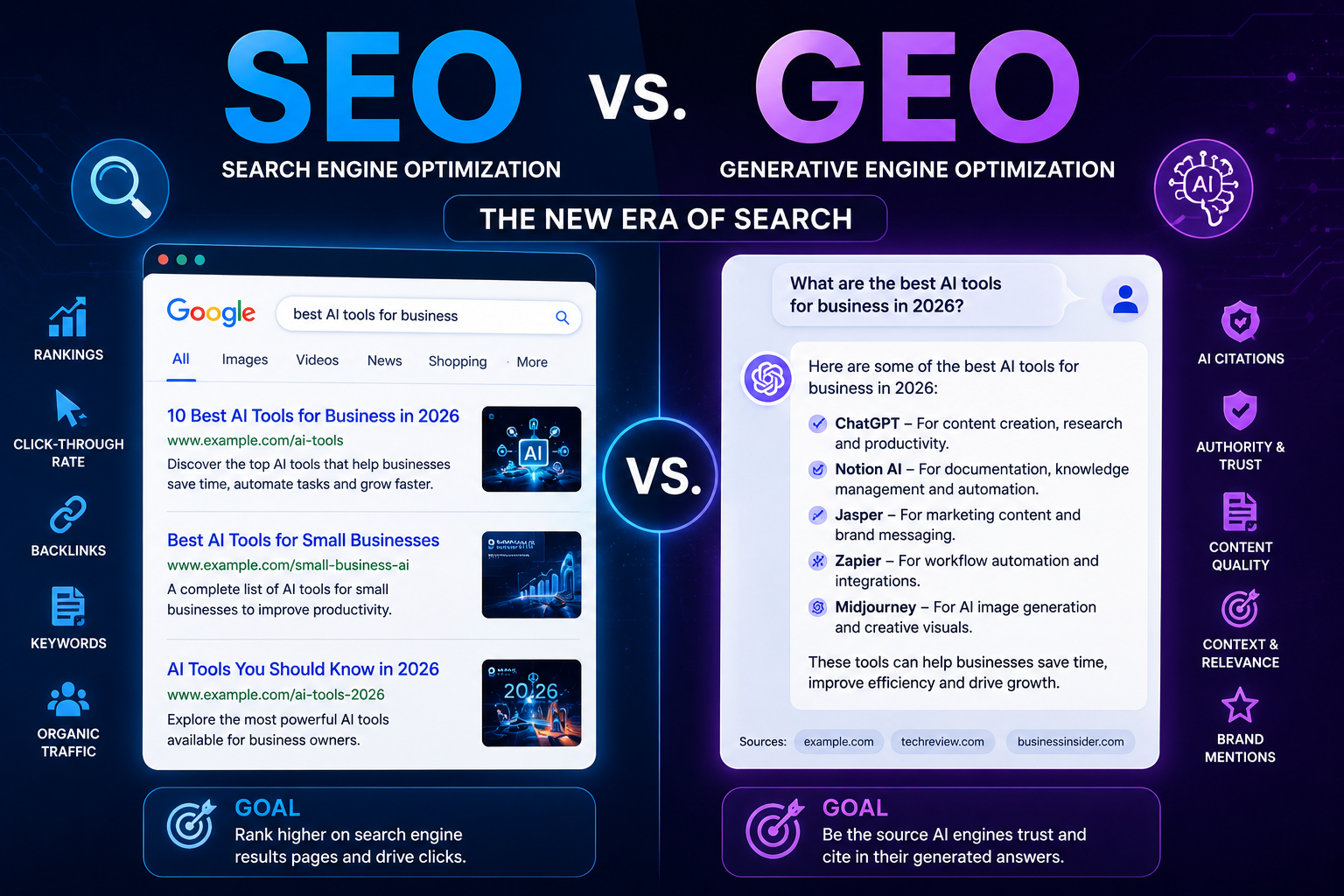
SEO vs GEO: Understanding the Future of Search in the Age of AI
Introduction
For decades, Search Engine Optimization (SEO) has been the primary strategy for improving online visibility. Businesses invested heavily in keywords, backlinks, technical optimization, and content creation to rank higher on search engines like Google and Bing.
However, the rapid growth of Artificial Intelligence is transforming how people discover information.
Today, millions of users are asking questions directly to AI platforms such as ChatGPT, Gemini, Claude, Perplexity, and AI-powered search engines. Instead of browsing through multiple links, users receive direct answers generated from information gathered across the web.
This shift has introduced a new concept known as Generative Engine Optimization (GEO).
While SEO focuses on ranking web pages in search results, GEO focuses on increasing the likelihood that AI systems will reference, cite, or use your content when generating answers.
Understanding the relationship between SEO and GEO is becoming essential for businesses, marketers, bloggers, and content creators.
What Is SEO?
Search Engine Optimization (SEO) is the practice of improving a website’s visibility in traditional search engines.
The primary goal of SEO is to rank higher for relevant keywords and attract organic traffic.
SEO typically focuses on:
- Keyword research
- Content optimization
- Backlink acquisition
- Technical website performance
- Mobile optimization
- User experience
- Internal linking
- Search intent matching
For example, if someone searches:
“Best AI tools for business”
Google displays a list of websites it considers most relevant.
SEO helps your website appear among those results.
What Is GEO?
Generative Engine Optimization (GEO) is the process of optimizing content so that AI systems can understand, trust, and reference it when generating responses.
Instead of optimizing for search rankings, GEO optimizes for AI citations and inclusion.
For example, a user might ask:
“What are the best AI tools for small businesses in 2026?”
Instead of displaying ten blue links, an AI assistant generates a direct answer.
The AI may draw information from multiple websites, combine insights, and present a concise response.
The websites influencing that answer are effectively benefiting from GEO.
Why GEO Matters
The rise of generative AI is changing user behavior.
Many users now prefer:
- Conversational search
- Direct answers
- Personalized recommendations
- AI-assisted research
Instead of searching:
“SEO strategies”
Users increasingly ask:
“What SEO strategies work best for small businesses in 2026?”
The AI generates an answer immediately.
If your content is not visible to AI systems, you risk losing visibility even if your website ranks well in traditional search.
SEO vs GEO: Key Differences
| SEO | GEO |
|---|---|
| Optimizes for search engines | Optimizes for AI systems |
| Focuses on rankings | Focuses on citations and references |
| Keyword-driven | Context-driven |
| Goal is clicks | Goal is inclusion in AI answers |
| Backlinks are critical | Authority and trust are critical |
| Measures traffic | Measures visibility and mentions |
| Search results pages | AI-generated responses |
How Search Behavior Is Evolving
Traditional Search Journey:
User → Search Engine → Website
Generative Search Journey:
User → AI Assistant → Answer
In many cases, users may never click through to a website.
This creates a significant challenge for businesses that depend solely on traditional SEO.
The future belongs to brands that can succeed in both environments.
How AI Systems Select Information
Although AI platforms use different technologies, they generally prefer content that demonstrates:
Authority
Content written by experts tends to be favored.
Author profiles, credentials, and industry experience help establish authority.
Accuracy
AI systems prioritize reliable and factually correct information.
Regular updates improve trustworthiness.
Clarity
Structured content is easier for AI to process.
Clear headings and concise explanations improve understanding.
Depth
Comprehensive articles often provide more useful context than short posts.
Trust
Websites with strong reputations are more likely to be referenced.
SEO Strategies That Still Matter
Many people believe GEO will replace SEO.
This is incorrect.
Several SEO principles remain extremely important.
High-Quality Content
Both search engines and AI systems prefer valuable content.
Technical Optimization
Fast websites improve user experience and accessibility.
Strong Site Structure
Organized websites help search engines and AI systems understand relationships between topics.
Topical Authority
Publishing multiple articles around a subject increases credibility.
For example:
AI Tools
→ AI Agents
→ AI Search
→ GEO
→ Prompt Engineering
Together these create topical authority.
GEO Strategies for the AI Era
1. Write for Questions
AI systems frequently respond to question-based queries.
Examples:
- What is GEO?
- How does AI search work?
- Is SEO still important?
Create content that directly answers these questions.
2. Add FAQ Sections
FAQs provide concise answers that AI systems can easily extract.
Example:
Q: Does GEO replace SEO?
A: No. GEO complements SEO by helping content appear in AI-generated responses while SEO continues to drive search engine visibility.
3. Use Clear Content Structure
Organize content using:
- H1
- H2
- H3
- Bullet points
- Tables
Structured information improves AI comprehension.
4. Demonstrate Expertise
Include:
- Author biographies
- Industry experience
- Original insights
- Case studies
Expert-driven content is more likely to be trusted.
5. Cite Credible Sources
AI systems favor content that references authoritative information.
Supporting claims with data increases credibility.
6. Cover Topics Comprehensively
Rather than publishing dozens of short articles, create in-depth resources that answer an entire topic.
Comprehensive content often performs better in both SEO and GEO.
The Role of E-E-A-T in GEO
Google emphasizes:
- Experience
- Expertise
- Authoritativeness
- Trustworthiness
These principles are becoming even more important for AI-generated search.
Content that demonstrates real experience is more likely to influence AI answers.
For businesses, this means sharing:
- Personal insights
- Industry knowledge
- Case studies
- Original research
rather than simply rewriting existing information.
Will GEO Replace SEO?
No.
The future is not SEO versus GEO.
The future is SEO plus GEO.
SEO helps people discover your content through traditional search.
GEO helps AI systems discover and use your content when generating answers.
Businesses that combine both approaches will achieve the greatest visibility.
What Website Owners Should Do Right Now
- Continue investing in SEO.
- Build topical authority around your niche.
- Publish comprehensive content.
- Add FAQ sections.
- Implement structured data.
- Strengthen author credibility.
- Update older content regularly.
- Create content that answers real user questions.
- Focus on expertise rather than keyword stuffing.
- Monitor how AI platforms reference your content.
Conclusion
The rise of AI-powered search represents one of the biggest shifts in digital marketing since the invention of search engines.
While SEO remains essential, Generative Engine Optimization is rapidly becoming a critical part of online visibility.
Organizations that create trustworthy, expert-driven, and well-structured content will have the best chance of appearing in both traditional search results and AI-generated answers.
The winners of the next decade will not be the businesses that choose between SEO and GEO.
They will be the businesses that master both.
Frequently Asked Questions
What does GEO stand for?
GEO stands for Generative Engine Optimization, the practice of optimizing content for AI-generated search results and answers.
Is GEO replacing SEO?
No. GEO complements SEO rather than replacing it.
Which is more important in 2026?
Both are important. SEO drives traditional search visibility, while GEO increases visibility within AI-generated responses.
How can I optimize for GEO?
Focus on expertise, structured content, FAQs, topical authority, trustworthy information, and comprehensive coverage of subjects.
Can small websites benefit from GEO?
Yes. High-quality expert content can be referenced by AI systems regardless of website size, creating opportunities for smaller publishers.
Related Post
Why Use Gemini Omni Over Other AI Video Models?
Honest answer: Omni isn't the best at everything. It's the best at one thing that…