
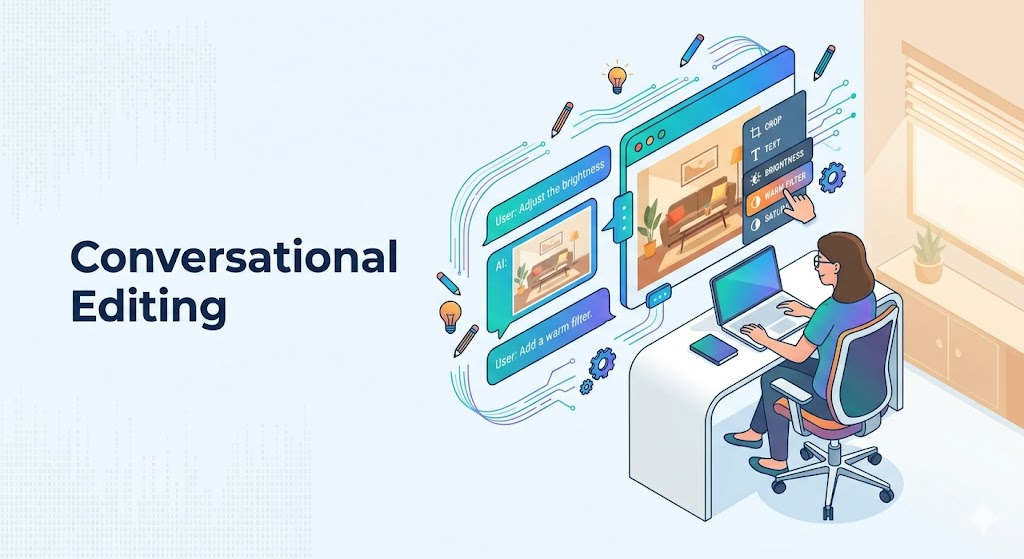
Conversational Editing Mastery
>> AI Knowledge Base>> Conversational Editing Mastery
Conversational Editing Mastery
This is Omni’s superpower and the part almost nobody teaches well. Master it and you stop “rolling the dice” on generations and start directing.
The one rule: one change per turn. Stack two changes and you invite drift. Editing is reliable for about 4 turns — at turn 5, consistency starts to wobble.
The 3 syntax patterns:
| Pattern | Syntax |
|---|---|
| Preserve + Change | “Change [X]. Keep [Y] and [Z] identical.” |
| Trigger + Action | “When [trigger], [effect].” |
| Add + Preserve | “Add [new element]. Keep everything else the same.” |
The most underused command:
Go back to the previous version. Omni remembers prior states, so you can branch — try a wild variant, decide it’s wrong, and return to the last good version. Veo and Sora can’t do this. Golden recovery line:
Go back to the previous version. Keep [the good part]. Change only [the bad part].
The 4-Turn Chain (worked example)
Turn 1: A video of a violinist playing a song.
Turn 2: Transport the violinist to the image environment. [attach reference image]
Turn 3: Make the violin invisible. Keep her hand positions and playing motion the same.
Turn 4: Change the camera angle to be over her shoulder. Keep the environment and lighting identical.
Character Consistency with @username (in Google Flow)
Create a character once (reference image + voice sample), name it
@maya, and summon it in any scene — same face, hair, outfit — without re-describing it.
Turn 1: @maya stands beside a classroom board and introduces kinetic energy. Keep her
glasses, jacket, hairstyle, face and calm gestures consistent.
Turn 2: Same @maya in a lab, demonstrating a rolling ball on a table. Keep her face,
hair, glasses and jacket unchanged. Match the previous lighting.
Session discipline: save your best frames as you go · start a fresh chat for a genuinely new idea (long sessions drift) · correct drift early — the longer you wait, the harder it is to recover.
Related Post
Beyond the Chatbot: Why 2026 belongs to “Agentic AI”
Remember when the tech world’s collective jaw dropped over chatbots that could write poetry or…