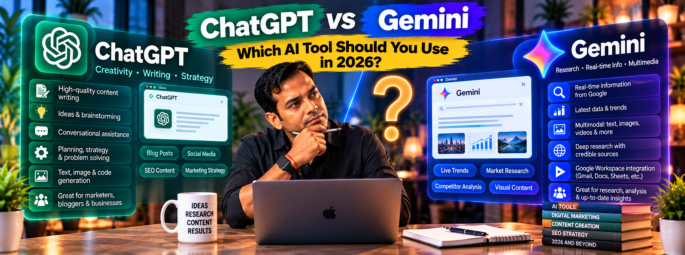
Choosing between ChatGPT and Google Gemini comes down to whether you need a versatile, autonomous task agent with top-tier reasoning and coding (ChatGPT) or a deeply integrated assistant with massive multimodal analysis and native Google Workspace connectivity (Gemini).
2026 Feature Comparison Matrix
| Feature / Metric | ChatGPT | Google Gemini | Key Advantage |
| Primary Model Architecture | GPT-5.6 Series (Luna / Terra / Sol) | Gemini 3.5 Series (Flash / Pro) | — |
| Context Window Capacity | ~128K – 400K tokens (up to ~1M on API) | 1,000,000 – 2,000,000 tokens | Gemini (Massive file/codebase capacity) |
| Multimodal Inputs | Text, Code, Documents, Images, Native Audio | Native Text, Audio, Images, Full Video | Gemini (Native video frame-by-frame analysis) |
| Coding & Terminal Agents | High execution accuracy, autonomous debugging | Strong snippet generation, good for scripts | ChatGPT (Superior multi-step terminal/agent loops) |
| Workspace Integration | Microsoft 365, Slack, Custom Connectors/MCP | Native Gmail, Docs, Drive, Sheets, YouTube, Maps | Gemini (Unmatched Google ecosystem integration) |
| Writing & Creative Tone | Highly natural, nuanced, and stylistically adaptable | Direct, structured, and factual | ChatGPT (Stronger for long-form prose and marketing) |
| Custom Extensibility | Massive Custom GPT Store, developer APIs | Gems, Extensions, lower-cost Flash APIs | ChatGPT (Ecosystem maturity & custom agent workflows) |
Key Core Differences
1. Coding, Technical Reasoning & Autonomous Agents
- ChatGPT: Remains the default standard for software engineering, multi-step agent execution, and technical troubleshooting. Its agent mode allows it to autonomously interact with browser environments, terminals, and external tools to execute end-to-end multi-step tasks.
- Gemini: Performs exceptionally well for code generation and explaining complex technical documentation, but requires slightly more manual intervention when handling complex, multi-file software refactoring.
2. Context Window & Multimodal Video Processing
- Gemini: Holds a clear lead in scale and multimodal breadth. With a 1M–2M token context window and native video understanding, you can upload hour-long video recordings, multi-hour podcast audio, or entire software codebases in a single prompt without losing context.
- ChatGPT: Handles image, text, and PDF analysis well, but lacks the native, long-form video processing power of Gemini.
3. Ecosystem & Real-World Integration
- Gemini: Operates directly inside your Google stack. It can summarize email threads in Gmail, extract data from Google Sheets, draft responses in Docs, and analyze YouTube content seamlessly.
- ChatGPT: Functions as an all-in-one standalone hub. It connects flexibly to third-party tools (Slack, GitHub, Microsoft 365, Notion) via Custom GPTs, plugins, and custom integrations, making it ideal if your workplace isn’t locked into Google.
4. Prose Quality, Creative Writing & Persona Tuning
- ChatGPT: Consistently produces smoother, less “robotic” prose for marketing copy, essays, and creative storytelling. It also adapts better to custom tone guardrails and complex persona instructions.
- Gemini: Direct, concise, and structured. Excellent for executive summaries, quick research synthesis, and outline building, though it can feel more matter-of-fact in longer creative pieces.
How to Choose
Choose ChatGPT if:
- You need an autonomous AI assistant for heavy coding, technical troubleshooting, or complex multi-step agents.
- Your primary tasks involve creative writing, marketing copy, or long-form content generation.
- You rely on custom workflows, specialized GPTs, or work outside the Google ecosystem.
Choose Gemini if:
- Your personal or professional life runs almost entirely on Google Workspace (Gmail, Drive, Docs, Sheets, Android).
- You regularly analyze long videos, audio files, massive PDFs, or full-project codebases.
- You prioritize direct access to live Google Search and quick real-time web research.
