

Beyond the Chatbot: Why 2026 belongs to “Agentic AI”
>> AI Knowledge Base>> Beyond the Chatbot: Why 2026 belongs to “Agentic AI”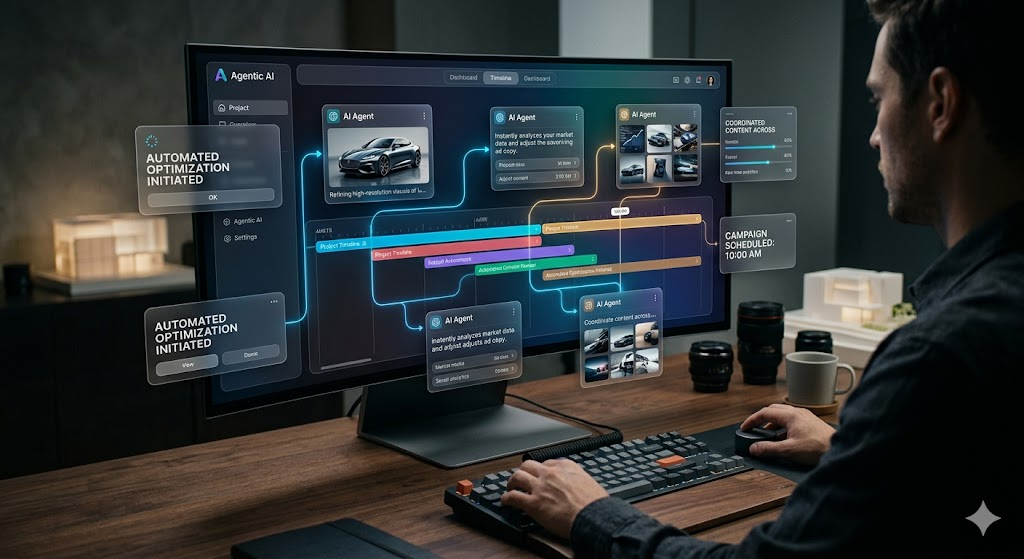
Beyond the Chatbot: Why 2026 belongs to “Agentic AI”
Remember when the tech world’s collective jaw dropped over chatbots that could write poetry or summarize a PDF? That era of simple, reactive “copilots” was a great introduction. But as we move through 2026, the tech landscape has hit a massive turning point.
The collective focus has shifted entirely away from isolated proofs-of-concept and experimental novelties. Instead, businesses and creators are demanding technology that earns its place by saving time, eliminating errors, and delivering actual, measurable value.
Enter Agentic AI—the defining shift from AI tools you simply talk to, to autonomous systems that work for you.
From “Answering Prompts” to “Executing Intents”
For the past few years, using generative AI meant typing a prompt, waiting for a response, and manually carrying out the next steps yourself. If you wanted to run a marketing campaign, you had to ask for a caption, manually copy it to a scheduler, adjust the image separately, and track the analytics yourself.
In 2026, the paradigm has evolved from “writing prompts” to “expressing intent”.
An AI Agent doesn’t just generate text; it plans steps, utilizes external digital tools, adapts to real-time changes, and handles complex, multi-layered workflows autonomously. You give it a high-level goal, and it orchestrates the execution from start to finish.
The Rise of Multi-Agent Systems (MAS)
The real magic happening right now is the emergence of Multi-Agent Systems. Instead of relying on one massive, generalized AI model to do everything, organizations are deploying networks of highly specialized AI agents that collaborate with one another.
Imagine a digital ecosystem where:
- Agent A continuously scans visual trends and compiles market data.
- Agent B takes that data and instantly generates optimized visual layouts and assets.
- Agent C reviews the work for brand alignment, double-checks the compliance guidelines, and schedules the publication across platforms.
By breaking large-scale, complex projects into specialized assembly lines, workflows that once took days or weeks are being condensed into minutes.
Why the Shift is Happening Now
The AI landscape has officially entered its “stability plateau”. The volatility of constant paradigm shifts has leveled out, allowing companies to stop chasing the hype of every minor weekly model release. Instead, tech infrastructure is becoming smarter, leaner, and more localized.
With massive breakthroughs in Edge AI and on-device processing, powerful models can now run locally right on your hardware rather than constantly pinging remote servers. This means lightning-fast execution, lower operational cloud costs, and significantly tighter data privacy.
The Bottom Line for Creators and Enterprises
The narrative surrounding AI in 2026 is no longer about amazement or novelty; it’s about industrialized adoption. The competitive edge no longer belongs to those who use the newest model, but to those who excel at orchestrating autonomous workflows.
As AI stops being a passive tool and becomes an active digital collaborator, the human role is rapidly shifting away from routine execution and toward strategic oversight, curation, and creative direction.
The question is no longer, “What can AI write for you?” It’s, “What workflow are you ready to delegate entirely?”
Related Post
The Rise of Generative AI: Creativity in the Age of Intelligent Machines
Generative AI is no longer a futuristic concept—it’s here, and it’s reshaping how we create,…